Adaptation, Translation, and Contextualization of Inclusive Learning Approach (ILA) Module (English to Nepali) and Provision of Training
1. Background
Parent Federation of Persons with Intellectual Disabilities (PFPID) Nepal, established in 2012, is a national umbrella organization dedicated to advocating for the rights of persons with intellectual disabilities (IDs). As part of its mission to promote inclusive education and societal participation, PFPID aims to build employer awareness and capacity through targeted training and accessible online resources. PFPID also fills the role of Thematic Lead (TL) for Inclusive Education in the CADiR Nepal country program (see below).
The Collective Action for Disability Rights (CADiR) Nepal is a consortium program project initiated in late 2023 and formally established in 2025. The consortium partners, PFPID, Nepal Association of the Blind (NAB) , National Federation of the Disabled Nepal (NFD-N), National Federation of the Deaf Nepal (NDFN), and Nepal Netra Jyoti Sangh (NNJS) Dang / Eye Health Program (EHP), have committed to collaborative efforts for optimal outcomes for persons with disabilities in Nepal.
In addition to Nepal, CADiR stretches across four additional country groups with similar consortia of Organizations of Persons with Disabilities (OPDs), as well as five more countries in Africa and Asia with fewer CADiR partners. The back donor is the Norwegian Agency for Cooperation and Development (Norad) and the global CADiR program stems from a five-year agreement between Norad and the Atlas Alliance (Atlas), the umbrella of Norwegian OPDs partnering with sibling OPDs in the global south for development and fulfilment of rights.
The project focuses on three key areas:
- Enhancing the ability of persons with disabilities to advocate for their right to inclusion in society.
- Strengthening the organizations in the consortium, and other key Nepali partners and stakeholders on disability rights and inclusion.
- Promoting more inclusive societal structures, laws, and systems in Nepal, across five thematic areas.
The Inclusive Learning Approach (ILA) is part of the CADiR Nepal plan within the thematic area Inclusive Education. Seven modules have been developed, originally by the Enabling Education Network (EE-Net), a long-term Atlas partner, and adapted by several Atlas partners over the years. The ILA aims to foster inclusive, equitable, and learner-centered educational practices. To maximize accessibility and relevance for Nepali-speaking educators, Organizations of Persons with Disabilities (OPDs), and other stakeholders, the modules must be adapted to align with Nepal’s educational framework, including the National Education Policy-2020, Compulsory and Free Education Act-2075, Local Government Operation Act-2074, and School Education Sector Plan (SESP 2022-2032). This adaptation should incorporate Nepal’s diverse cultural, linguistic, and social contexts, such as multilingual classrooms, caste and ethnic inclusivity, gender equity, and accessibility for remote and marginalized communities, while addressing challenges like geographical disparities and resource constraints in rural areas.
2. Role of the Consultant
The consultant will lead the adaptation of the ILA modules to ensure they resonate with Nepal’s unique educational landscape, including integration with government curricula and coordination with Centre for Education and Human Resource Development (CEHRD) and local pedagogical practices. This involves contextual modification, accurate translation into Nepali, and the design and delivery of a Training. The consultant bears full responsibility for ensuring the modules promote inclusivity, respect Nepal’s federal structure (with emphasis on provincial and local education governance), and address barriers faced by children with disabilities in diverse settings, such as urban vs. rural schools.
3. Objectives
The primary objectives of this consultancy are:
- To adapt and translate the ILA Modules from English to Nepali, ensuring cultural relevance, alignment with Nepal’s national education policies, and preservation of inclusive principles.
- To make the content accessible, gender-sensitive, and responsive to Nepal’s social nuances, including ethnic diversity (e.g., incorporating examples from indigenous groups like Tharu or Newar communities) and disability spectrum (e.g., intellectual, visual, deafblind and complex disability and physical disabilities).
- To design and conduct a training program that equips stakeholders with skills to implement the adapted modules, fostering sustainable inclusive education practices across Nepal’s provinces.
- To train the group of core ILA educators in all modules once finished in accordance with a timeline agreed with PFPID.
4. Scope of Work
The consultant will undertake the following tasks:
- Take an online course (the Virtual study Tour), and adhere to live online guidance from EE-Net (two-three sessions) at the onset of the assignment.
- Review the existing English ILA modules with this knowledge fresh in mind and identify modifications needed for alignment with Nepal’s education system, such as integrating references to the Constitution of Nepal (2015) provisions on inclusive education, the Disability Rights Act (2017), and local curricula standards.
- Adapt content to incorporate Nepali-specific examples, case studies, and scenarios (e.g., addressing earthquake-prone regions’ accessibility needs or multilingual instruction in Terai and Himalayan areas).
- Translate the full set of modules into clear, accurate, and reader-friendly Nepali, using Devanagari script and ensuring consistency in terminology related to inclusive education (e.g., “समावेशी शिक्षा” for inclusive education) as per government guidelines.
- Employ simple, culturally appropriate, gender-sensitive, and disability-inclusive language, avoiding biases and promoting equity for marginalized groups like Dalits, women, and indigenous people.
- Maintain the original structure, formatting, references, and visual elements, while enhancing accessibility features (e.g., suggestions for easy-read versions, Braille compatibility, or audio adaptations).
- Incorporate feedback from CADiR’s Inclusive Education Thematic Group and other stakeholders during iterative reviews, making revisions as needed.
- Develop a detailed curriculum, and facilitation plan tailored to diverse participants (e.g., educators, OPD representatives, and government officials from different provinces), emphasizing practical, hands-on sessions on inclusive pedagogy.
- Facilitate the Training sessions to all the relevant school authorities, and teachers as per the inclusive education thematic area of CADiR program, ensuring interactive methods that account for Nepal’s cultural norms (e.g., group discussions respecting hierarchical social structures) and logistical challenges.
5. Deliverables
Phase 1:
- An adapted and fully translated Nepali version of the ILA Modules in editable format (e.g., MS Word), including contextualized content and alignment with Nepali educational standards.
- Developed training curriculum according to the adapted ILA, aligning with the Nepali context.
- Accompanying PowerPoint presentations customized for delivery in targeted schools, incorporating visual aids relevant to Nepali contexts (e.g., images of local classrooms or disability-inclusive activities).
- A final revised version of the modules and presentations, incorporating all reviewer feedback.- A comprehensive facilitation package, including session plans, participant materials, and a post-training evaluation report summarizing outcomes, challenges, and recommendations for scalability.
Phase 2:
- Conduct training sessions in the selected model schools with attendance records and feedback forms, in a series of training courses to get through all the modules at times convenient for the model schools.
6. Duration and Timeline
The first phase of the assignment is expected to be completed within 60 days from the date of contract signing. Phase 2 shall be conducted in the consequent years after completion of phase 1.
Phase 1:
- Review and initial adaptation planning.
- Adaptation, translation, and drafting.
- Initial review and revisions.
- Training design and facilitation.
Phase 2:
- The consultant should deliver a series of training sessions on the seven developed modules to the model schools of the CADiR project in Bara and Morang districts.
7. Required Qualifications and Experience
- PhD /Master’s degree in Education, preferably Masters in Inclusive and Special Needs Education or related subject.
- At least 10 years of professional experience in Nepal’s education sector.
- Experience as a trainer of in-service teachers or the teacher educating departments in Nepali universities, with a deep understanding of disability diversity, including methodologies like easy-read formats, Braille, sign language integration, Curriculum adaptation, Behavior management and universal design for learning (UDL).
- Proven track record in adapting and translating educational materials from English to Nepali, with experience in contextualizing content for Nepal’s multicultural society.
- Strong proficiency in both English and Nepali, with familiarity in local dialects as an asset.
- Strong proficiency in digital tools.
- Demonstrated understanding of inclusive education, including experience with teaching children with and without disabilities in the same classrooms of Nepali schools, and knowledge of and international laws.
- Experience facilitating inclusive training sessions for diverse groups, including rural communities and OPDs, with sensitivity to gender, caste, and ethnic dynamics.
- Ability to meet deadlines, incorporate feedback efficiently, and work collaboratively in a federal context.
- Knowledge about the use of Assistive Technology, devices, teaching and learning materials, and disability inclusive environments.
- Priority will be given to candidates who have completed either a long-term or short-term academic course in inclusive education.
8. Coordination and Reporting
The consultant will collaborate closely with CADiR’s Inclusive Education Thematic Group and report directly to the Thematic Lead. Regular check-ins (e.g., bi-weekly virtual meetings) will be required during adaptation, translation, and training phases to ensure alignment with project goals.
9. Payment Terms and Budget
The consultant shall submit an estimated budget covering adaptation, translation, training design, facilitation, and related costs.
10. Confidentiality and Ownership
All adapted, translated and produced materials under this assignment will remain the intellectual property of PFPID-Nepal and the CADiR consortium IE partners. The consultant must maintain strict confidentiality regarding all documents, data, and information shared during the consultancy, adhering to Nepal’s data protection norms.
11. Application process:
Interested candidates can email a letter of interest and the following documents:
- Cover letter outlining the following:
- Consultant's professional background
- Relevant skills, experience and qualifications
- PAN/VAT registration card
- An updated Curriculum Vitae
- Technical Proposal: Proposed approach and methodology for developing ILA module
- Financial Proposal: Detailed cost breakdown.
12. Submission Deadline
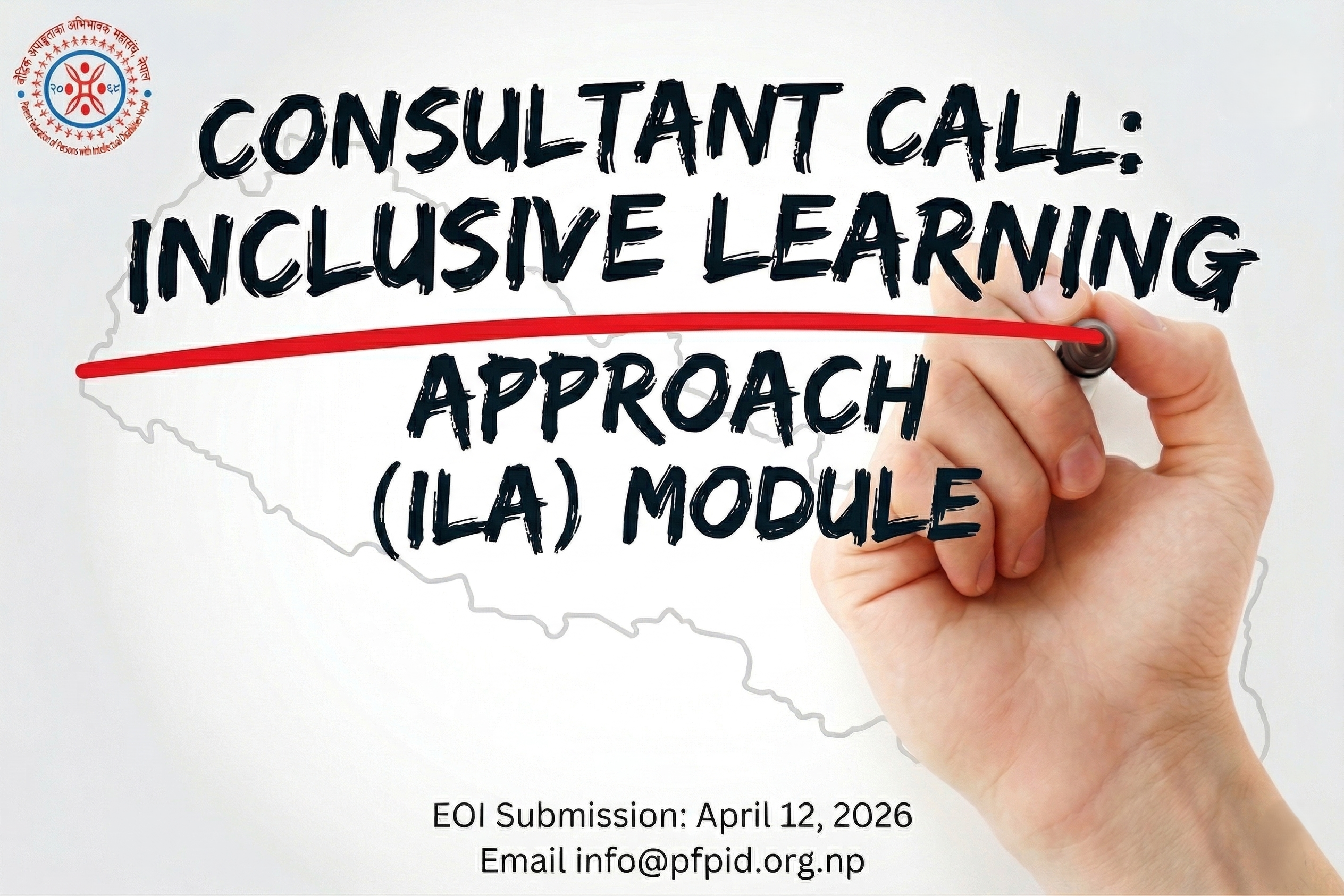
All applications must be submitted by April 12, 2026 to our email – info@pfpid.org.np with the subject line: Application for development of ILA Module – PFPID Nepal.


![[DEADLINE EXTENDED Till 17th June 2023] Opportunity for Consultant Service on Manual Development](https://pfpid.org.np/wp-content/uploads/2023/06/consultant1-768x506.png)